
The short version
- Pick one kind of cleaning and one area to start in.
- Choose sole trader or limited company, and register with HMRC when you need to.
- Insure before you work, and again before you hire.
- Sort the small print: data protection, chemicals, DBS checks and right to work.
- Work out what an hour really costs you, then price above it.
- Set up booking, payment and your diary before the first customer.
- Win ten regulars, not fifty one-off jobs.
- Hire carefully: status, wages, holiday, pension and the new 2026 rules.
- Put your systems on rails before you are busy.
1. Decide who you clean for
Most cleaning businesses that struggle started as “cleaning, for anyone, anywhere”. The ones that grow start narrow: one kind of customer, one area, one clear promise. You can widen later. Here are the five most common starting points.
Domestic regulars
- How the work usually looks
- Weekly or fortnightly visits to the same homes, mostly in the daytime
- Why start here
- Repeat income, word-of-mouth referrals, and your route gets tighter as you add neighbours
- Watch out for
- Cancellations, keys and alarm codes, and no single customer worth much on their own
End of tenancy and deep cleans
- How the work usually looks
- One-off, checklist-driven jobs, often booked by landlords and letting agents
- Why start here
- A higher price per job, and agents send work again and again
- Watch out for
- Uneven income, tight deadlines, and inspections that can send you back
Offices and commercial
- How the work usually looks
- Contract work, often early morning or evening
- Why start here
- Steady, larger contracts once you win them
- Watch out for
- Insurance and tender requirements, payment terms, and needing staff early
Holiday lets and short-term rentals
- How the work usually looks
- Turnovers between guests, with linen and restocking
- Why start here
- Frequent repeat jobs from the same hosts
- Watch out for
- Same-day windows, weekend work, and a lot of coordination
Specialist services
- How the work usually looks
- Carpets, upholstery, ovens or windows, alone or as add-ons
- Why start here
- Skilled work with better margins
- Watch out for
- Equipment cost, training, and extra safety and insurance rules for anything at height
None of these is the right answer for everyone. Pick the one that fits the hours you can work, the area you know and the customers you can reach this month.

Whichever you choose, aim for regular work over one-off work. A customer who books every fortnight is 26 bookings a year, and each one costs you almost nothing to win after the first. The first clean is the audition: offer a standing slot before you leave.
2. Choose your business structure
The two usual choices are sole trader and limited company. You can start as a sole trader and move to a limited company later, and many people do exactly that. An accountant can tell you when the switch pays for itself, and a first conversation is usually cheap.
Sole trader
- You and the business are the same legal person: simple to start, and you are personally responsible for its debts.
- You can start trading before you register. You must register for Self Assessment once your gross trading income goes over £1,000 in a tax year, by 5 October in the following tax year.
- The £1,000 trading allowance lets you deduct up to £1,000 instead of your actual expenses. If your real costs are higher, claim them instead.
- Choose your business name early. You can trade under your own name or a trading name.
Limited company
- The company is a separate legal entity, which can protect your personal assets in many situations.
- It costs £100 to incorporate online at Companies House at the time of writing; check the current fee before you apply.
- You take on more admin: annual accounts, a confirmation statement, corporation tax and director duties.
- Commercial clients sometimes prefer to contract with a limited company.
Whichever you pick, open a separate business bank account. It is not a legal requirement for a sole trader, but it makes your records, your tax return and your accountant’s job far simpler.
Cleaning Operator is not accounting software, and it does not replace your accountant’s package. What it does is keep your bookings, charges, invoices and payroll in one record, so there is one place to look when the accounts are due.
3. Insurance: what the law requires and what customers expect
- Employers’ liability insurance is the law once you employ anyone. You need at least £5 million of cover from an authorised insurer, you must display the certificate, and you can be fined £2,500 for every day you are not properly insured. You do not need it if you only employ close family, and a sole trader with no staff does not need it.
- Public liability insurance is not a legal requirement for most businesses, but you should treat it as one. It covers claims if someone is injured or their property is damaged because of your work: a broken vase, a flooded bathroom. Letting agents, offices and many homeowners will ask to see the certificate before they let you in.
- Ask your broker about equipment and keys. Cover for your tools and for the cost of replacing a customer’s locks if you lose their keys is worth a conversation, and so is how the insurer treats cleaners who work for you as self-employed.

4. The small print most guides skip
Data protection
You will hold names, addresses, phone numbers and often access codes. Most organisations that handle personal information must pay the ICO’s data protection fee unless they are exempt. For the smallest organisations it is currently £52 a year, with £5 off if you pay by Direct Debit. The ICO’s free self-assessment tells you in a couple of minutes whether you need to pay.
Chemicals and safety
If you employ people, you have a legal duty under the COSHH regulations to assess and control the risks from hazardous substances. Even working alone it is sensible practice: read the labels and safety data sheets, never mix products, store them safely and train anyone who works for you.
DBS checks
A basic DBS check shows unspent convictions and conditional cautions. It costs £20 from 5 October 2026 (it was £21.50). It is generally not a legal requirement for ordinary domestic or office cleaning, but customers who give you a key will often expect it, so ask every cleaner to provide a basic DBS certificate. Work in places such as schools or care homes can require a higher level of check, and the client will tell you which.
Right to work
Before you employ anyone you must check they are allowed to work in the UK. You can use an online share code, check original documents in person, or use an identity service provider. British and Irish citizens cannot get a share code, so you check original documents or use a provider. Keep a record of every check.
5. Price it properly: what an hour really costs
New owners usually price by looking at what other local cleaners charge. That is a useful check, but it is not a method. The method is to know what an hour of your cleaner’s time costs you, add what the wage does not cover, and then add the margin that keeps you in business.
Here is an illustration for one employed cleaner on the National Living Wage (£12.71 an hour for those aged 21 and over from April 2026), working 20 hours a week.
| Weekly cost | Amount |
|---|---|
| Wages for 20 hours at £12.71 | £254.20 |
| Holiday pay (5.6 weeks a year, about 12% of the hours worked) | £30.68 |
| Employer National Insurance (15% above £96 a week) | £28.33 |
| Employer pension contribution (3% of qualifying earnings) | £4.95 |
| Total weekly cost | £318.16 |
| Cost per hour worked | £15.91 |
An illustration using 2026 to 2027 figures from GOV.UK, not advice. The Employment Allowance (up to £10,500 a year for eligible employers) can reduce the National Insurance part, and your accountant will confirm what applies to you.
So a £12.71 wage is closer to £15.91 an hour before you have bought a single bottle of spray. Then add what the wage does not cover: travel between jobs, supplies and equipment, insurance, software and your own admin time. Travel between customers during the working day usually counts as paid working time too, which is the cost new owners most often forget.
A simple way to set an hourly price: (cost per hour + overhead per hour) ÷ (1 − the margin you want). If you assume £2.50 an hour of overhead and a 30% margin, that is (£15.91 + £2.50) ÷ 0.70 = £26.30 an hour. Those two assumptions are placeholders: use your own, then compare the result with what local customers actually pay before you settle on a price.
Pricing choices that protect your margin
- Set a minimum visit length, so a 45-minute clean across town does not cost you the afternoon.
- Price extras separately (inside the oven, the fridge, windows, ironing) with a quantity where it makes sense.
- Give a recurring discount deliberately, instead of haggling at the door.
- Agree a cancellation policy in writing and take card details up front, so a last-minute cancellation does not become your loss.
6. Set up before your first booking
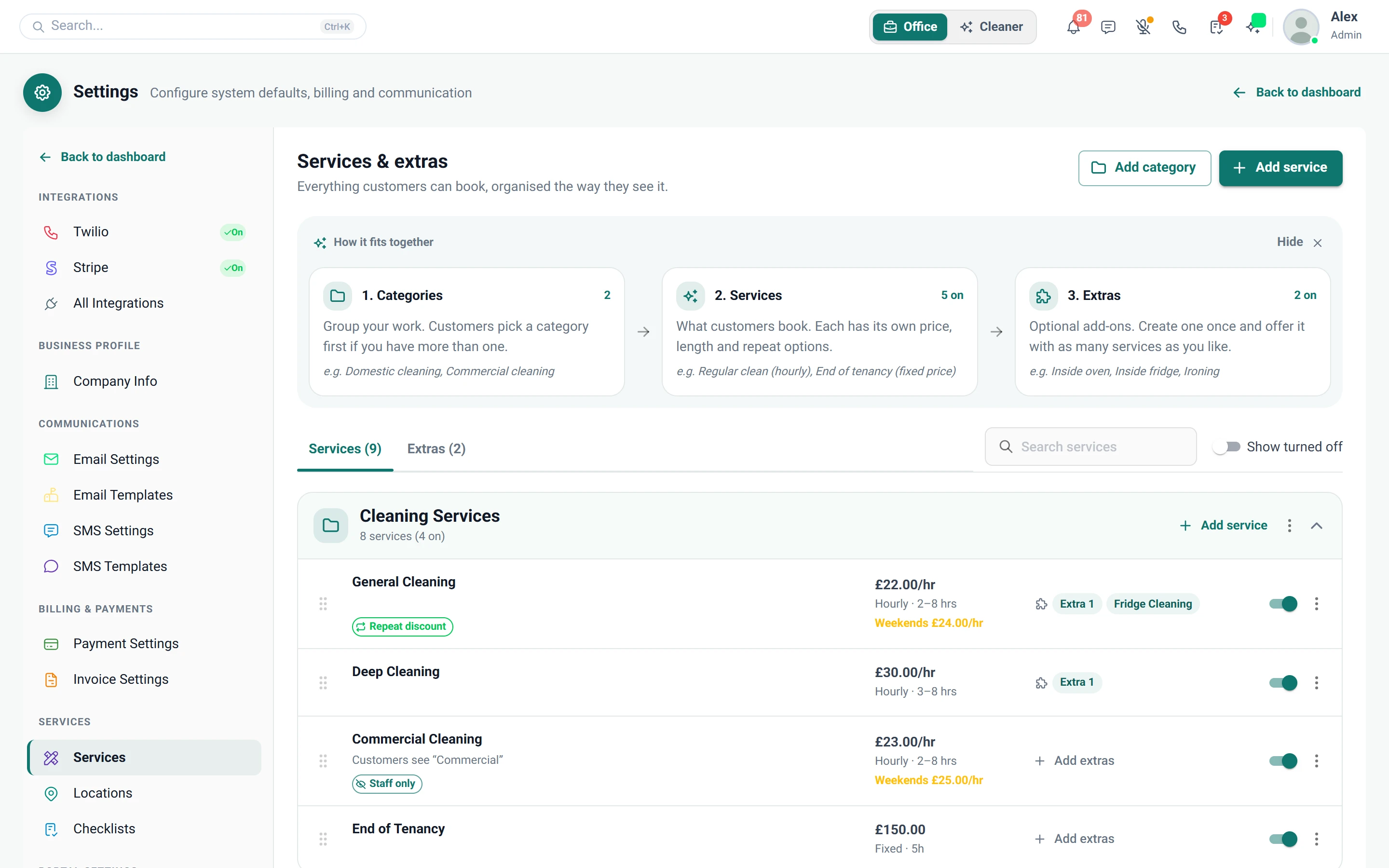
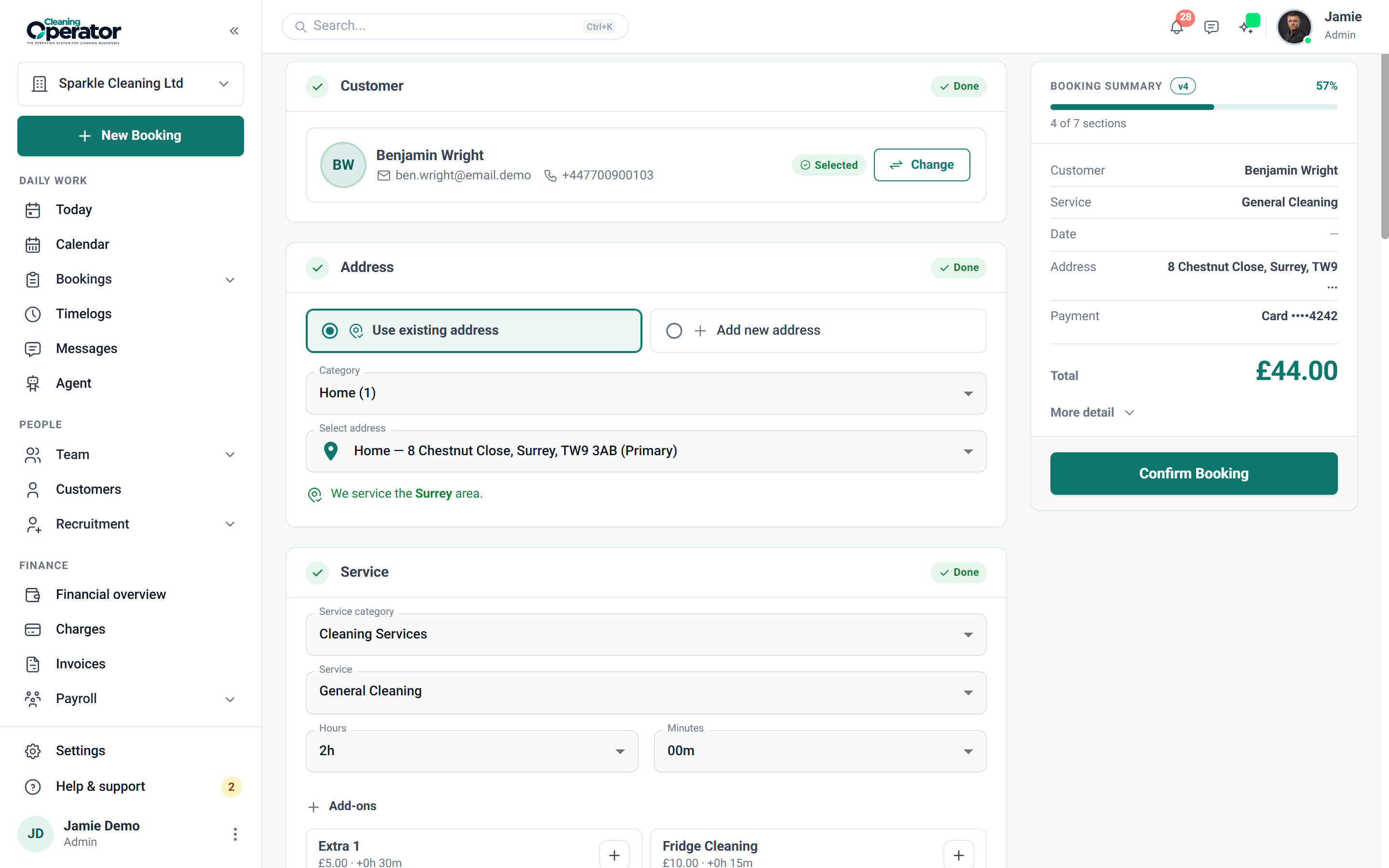
You do not need software to clean your first house. You need it the week you can no longer hold the diary in your head. Either way, get these in place before the first customer so you never have to do them in a hurry:
- A business bank account, and a business email address and phone number.
- Your insurance certificate, ready to send.
- A written price list, minimum visit and cancellation policy.
- A way for customers to book that works while you are cleaning, so you stop playing phone tag.
- A free Google Business Profile for your area, so you appear when people search for cleaners near them.
- A simple, secure way to store keys and alarm codes, and a rule about who can see them.
7. Win your first ten customers
Your first ten customers will mostly come from places you can reach this month. Work through these in roughly this order:
- Tell everyone you know, and ask each of them to tell one person. The first few cleans are usually friends of friends.
- Claim your Google Business Profile and ask every happy customer for a review straight after the clean, while it is fresh.
- Give people somewhere to book. A one-page website with your areas, your prices and a booking link turns interest into a booking while the customer is still interested.
- Go where your niche is. Local community groups for homes, letting agents and landlords for end-of-tenancy work, hosts for holiday lets, and a short, polite email to small offices.
- Offer the standing slot. Before you leave the first clean, offer the same time next week or next fortnight.
Reply fast. A customer who messages three cleaners will usually book the first one who answers with a price and a time.
8. Hiring your first cleaner
At some point the diary fills and you have to choose: turn work away, or hire. Before you advertise, decide how the person will work for you, because that decides your legal duties.
Employee, worker or self-employed?
Whether someone is an employee, a worker or genuinely self-employed depends on how the work is really done, not on what the contract calls them. Courts and tribunals make the final decision. If you decide when, where and how they clean, and they cannot send someone else in their place, treat them with caution as self-employed. Take advice from Acas or an employment adviser before you set up a team of self-employed cleaners, because getting this wrong can be expensive.
If you employ people
- Check their right to work before they start.
- Register as an employer with HMRC before your first payday. You can register up to two months before you start paying people, and you will receive an employer PAYE reference.
- Run payroll through PAYE and give payslips.
- Pay at least the National Minimum Wage or National Living Wage.
- Give statutory holiday: 5.6 weeks a year, which is 28 days for someone working five days a week.
- Enrol eligible workers in a workplace pension. The minimum is 3% from you and 5% from them, on earnings between £6,240 and £50,270 a year.
- Take out employers’ liability insurance and display the certificate.
| Age | Hourly rate |
|---|---|
| 21 and over (National Living Wage) | £12.71 |
| 18 to 20 | £10.85 |
| Under 18 | £8.00 |
| Apprentice | £8.00 |

9. Run the week without a whiteboard
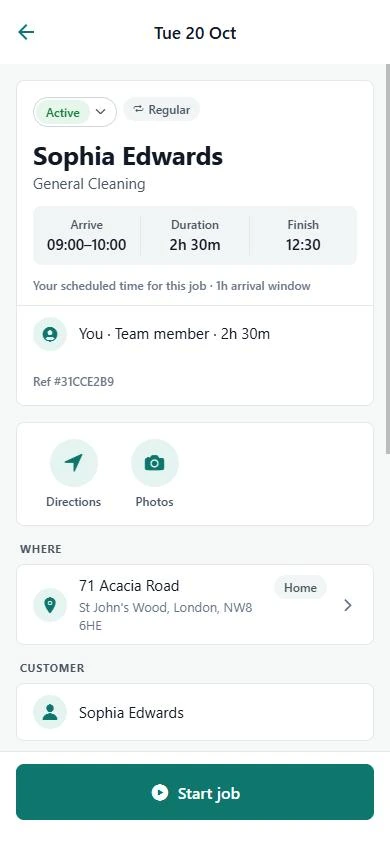
Every cleaning business runs the same loop: a customer books, you assign a cleaner, the clean happens, you get paid, you pay your team, and you ask for a review. When it works, it is invisible. When it breaks, it is usually one of these: a double booking, a cleaner who did not know the door code, a card that was never charged, or a payroll built from memory.
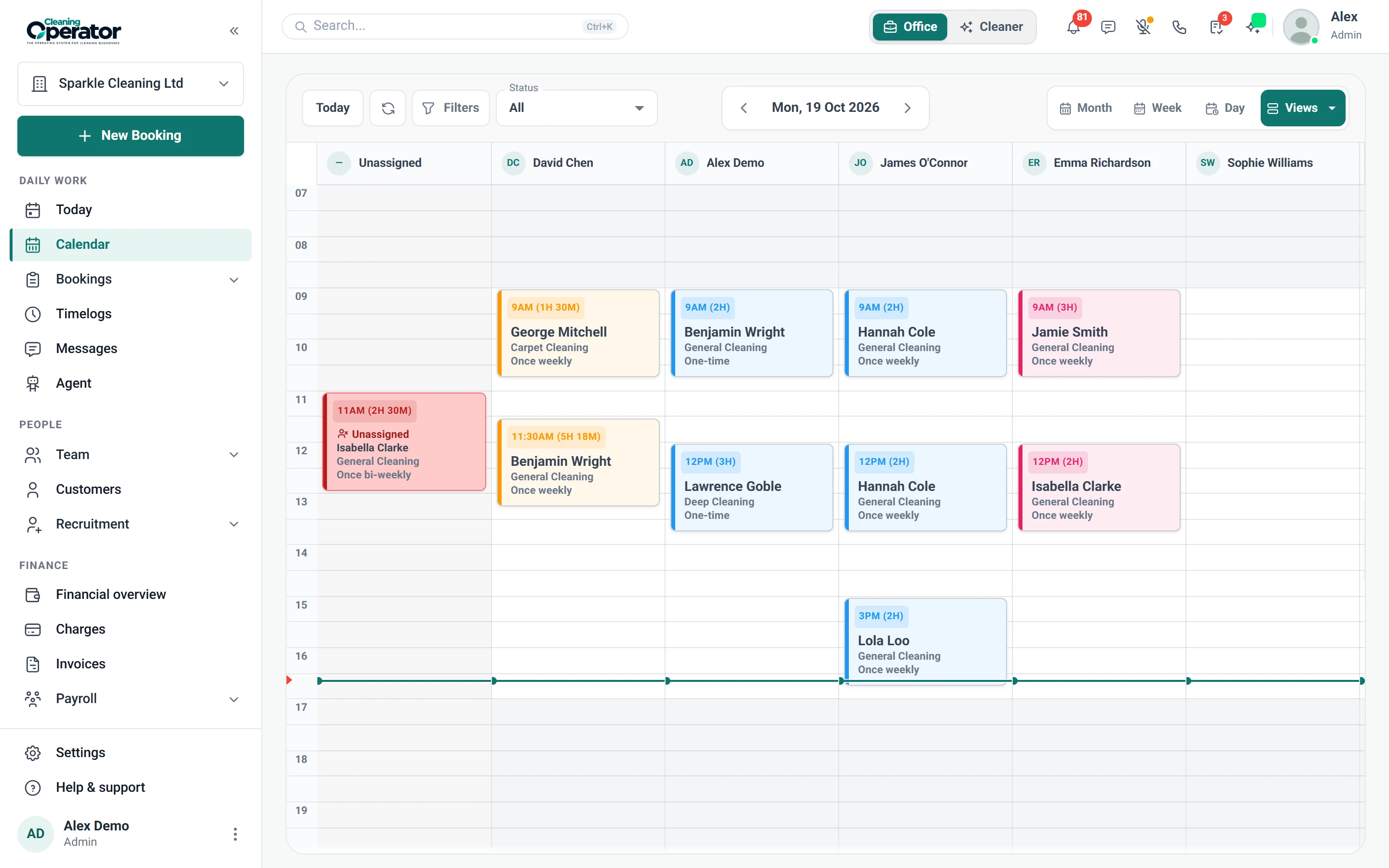
Cleaning Operator runs that whole loop in one place, built for cleaning companies and nothing else. Online booking, the team calendar, the mobile app for cleaners and the office, card payments, invoices and payroll from clocked hours all work from the same bookings, customers and cleaners.
Cleaning Operator plans
Professional
£59 pounds per month$79 US dollars per month a month
For small cleaning teams getting bookings, the calendar and payments in one place.
- 8 cleaner accounts
- 3 office users
- 1 service category
Business
£119 pounds per month$149 US dollars per month a month
For growing companies that need payroll, team views, recruitment and their own website.
- 20 cleaner accounts
- 10 office users
- 3 service categories
Enterprise
£199 pounds per month$249 US dollars per month a month
For larger operators that need more seats, the AI assistant, their own domain and data export.
- 100 cleaner accounts
- Unlimited office users
- Unlimited service categories
Card payments run through your own Stripe account, and SMS and calls on the Business plan and above run through your own Twilio account. Every plan has a 14-day free trial, with no card needed to start, and you can cancel anytime.
10. Your first 90 days
| When | What to get done |
|---|---|
| Weeks 1 and 2 | Pick your niche and area. Choose sole trader or limited company. Get insured. Open a business bank account. Write your price list and cancellation policy. |
| Weeks 3 and 4 | Set up your booking page and Google Business Profile. Take your first customers and ask for a review after each one. |
| Month 2 | Offer a standing slot on every first clean. Track your real hours, travel and costs so you can check your price. Register for Self Assessment if your income will go over £1,000. |
| Month 3 | Decide whether to hire. If you do, sort status, right to work, employer registration, payroll, pension and employers’ liability cover before the first shift. |
11. Mistakes that sink new cleaning businesses
- Pricing off the wage alone. Holiday, National Insurance, pension, travel and supplies all come out of your margin.
- Chasing one-off jobs. They feel like income, but regulars are where the profit is.
- Skipping the cancellation policy. A free cancellation at 7am costs you the cleaner’s morning.
- Mixing personal and business money. It makes tax time, and any VAT or Making Tax Digital threshold, hard to see coming.
- Hiring before checking. Right to work, a signed contract and the right insurance come before the first shift, not after.
- Letting the diary live in your head. It works until the first sick day, the first double booking, or the first holiday.
Questions answered
Do I need qualifications or a licence to start a cleaning business in the UK?
There is no general licence or qualification you must have to start a domestic or office cleaning business. Specialist work, such as working at height, handling certain chemicals or cleaning sensitive sites, can come with extra rules and insurance requirements, so check before you offer it.
How much does it cost to start a cleaning business?
Start-up costs depend on your niche and whether you hire. The fixed costs you can price today are small: a limited company costs £100 to incorporate online, a basic DBS check is £20, and the ICO data protection fee is £52 a year for the smallest organisations. Add insurance, equipment and supplies, which vary by insurer and by the kind of work you do.
Do I need public liability insurance?
It is not a legal requirement for most businesses, but customers, letting agents and commercial clients will usually ask for it. Employers’ liability insurance, with at least £5 million of cover, is the legal requirement once you employ anyone.
Should I be a sole trader or a limited company?
A sole trader is the simplest way to start, and you register for Self Assessment once your gross trading income passes £1,000 in a tax year. A limited company separates you from the business and costs more admin. An accountant can tell you when moving makes sense for your numbers.
Do I have to charge VAT?
Only once your taxable turnover goes over £90,000 in any rolling 12 months. You then have 30 days after the end of that month to register.
Is a DBS check a legal requirement for cleaners?
Not generally for ordinary domestic or office cleaning, but many customers expect one when they give you a key, and some sites, such as schools and care homes, can require a higher level of check. A basic check costs £20 from 5 October 2026.
Can I use Cleaning Operator as a one-person business?
Yes. Professional includes online booking, the calendar, customer records, card payments, invoicing and the mobile app, and the setup wizard has a solo path. Every plan has a 14-day free trial.
Sources
Figures and rules in this guide were checked against the pages below on 24 October 2026. Rates and thresholds change, usually in April, so check the source before you act on a number.
- Set up as a sole trader (GOV.UK)
- Tax-free allowances on property and trading income (GOV.UK)
- Register your company (GOV.UK)
- VAT registration: when to register (GOV.UK)
- Making Tax Digital for Income Tax (GOV.UK)
- Employers’ liability insurance (GOV.UK)
- Data protection fee (ICO)
- DBS fees from 5 October 2026 (GOV.UK)
- Check a job applicant’s right to work (GOV.UK)
- National Minimum Wage and National Living Wage rates (GOV.UK)
- Rates and thresholds for employers 2026 to 2027 (GOV.UK)
- Holiday entitlement (GOV.UK)
- Workplace pensions: what you, your employer and the government pay (GOV.UK)
- Register as an employer (GOV.UK)
- Employment status (GOV.UK)
- Employment Rights Act timeline update (GOV.UK)
This guide is general information for people starting a cleaning business in the UK. It is not legal, tax or financial advice, and it is not a substitute for an accountant, an insurance broker or an employment adviser who knows your situation.
Try it free
Run your cleaning business from one system.
Online booking, the team calendar, the mobile app for cleaners and the office, card payments, invoices and payroll from clocked hours.
14-day free trial on every plan. Cancel anytime, no lock-in contract.